EA Launch - Stars Reach Deep Dive
This is my second Stars Reach Deep Dive - a series in which we take a closer look at the intricacies, game design and gameplay mechanics of Raph Koster’s new, currently in-development MMORPG.
“Wait a minute!” - I hear you say - “This one is titled ‘EA Launch’, that’s not about game design!”. Oops, you caught me there. This post is going to be a bit of an exception for this series - but we are still going to look at this from a game design perspective! That’s where my main interests lie after all, and believe it or not - some of the statistics and numbers of this EA launch do clearly point at game design causes.
Other EA Launches
Looking at the statistics of a dozen of different games that launched into EA within the last few years, the only thing I noticed is, that the first two weeks tell you very, very little.
I picked a few examples for you, to show what I mean:
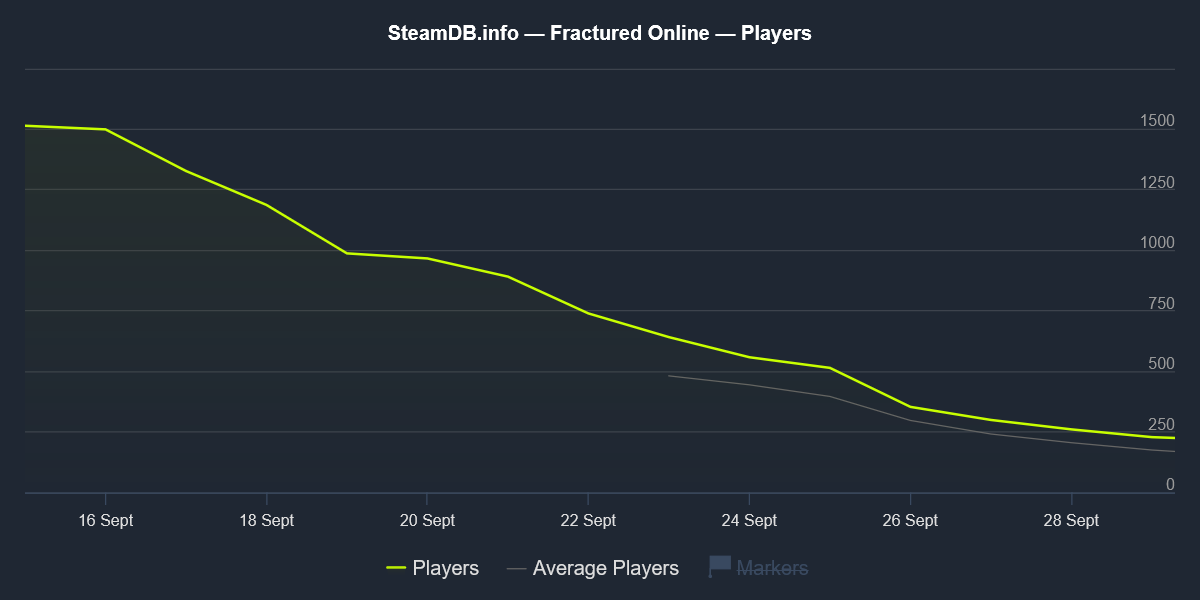
Fractured Online is an indie sandbox MMORPG that launched into EA in 2022 at a $30 price point. Over it’s first two weeks, every day has less players than before, and it then continues on like that, until it hits 0 players. Over the next few years it did several different things: an “EA relaunch” (568 players), a “1.0 release launch” (291 players) and a “free to play launch” (386 players) - all of which brought back a few hundred players - but then again showed the same pattern: fewer and fewer players every day. The game finally fizzled out in July 2025 - 3 years after that EA launch shown in the graph above.
Let’s look at a different example then:
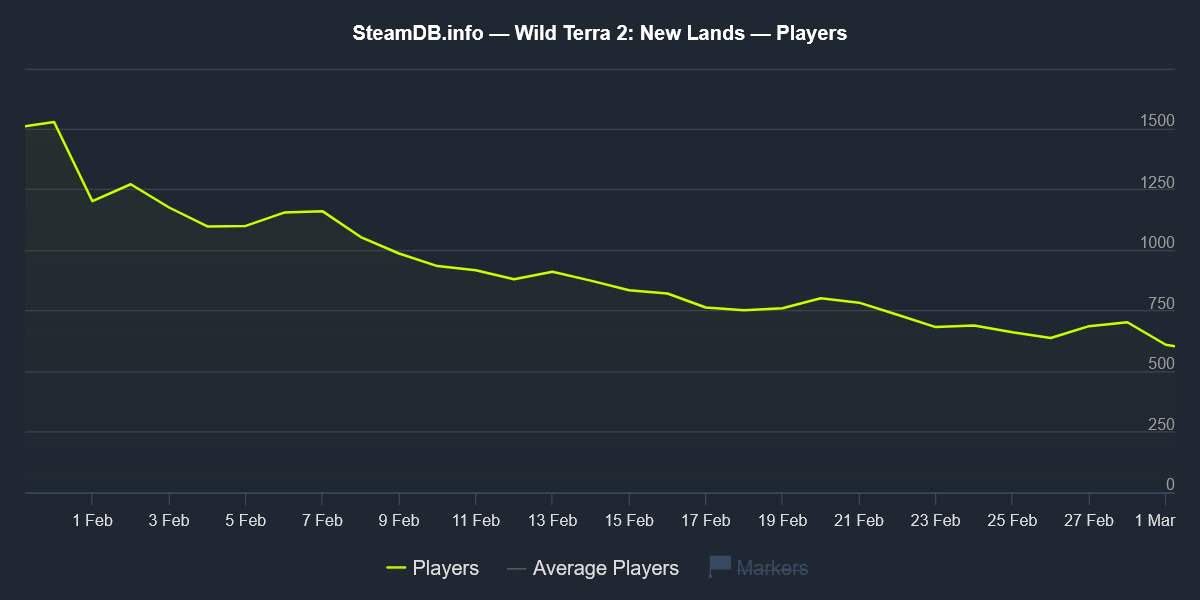
Wild Terra 2 is an indie sandbox MMORPG that launched into EA in 2021 at a $20 price point. Over it’s first month, the player numbers see a steady decline. There’s a tiny little uptick at the start of each weekend - but the overall trend is clearly downwards. It never hit 0 though - numbers went as low as 61, but then the game released it’s 1.0 launch and hit 356 players, which then went down to about 100 to 200 players which kept the game alive for five years. And just last December, and then again this June, they had big special sale peaking at 3,859 and 2,398 players respectively. As I am writing this, there are 674 players online and playing that game. The sale seems to have been a bit controversial though, ratings have gone down to mixed (51%), and we don’t know yet where the new stable population will end up. Will it go down to 100-200 again? Not a huge success - but so far the game hasn’t shut down either. It’s still running, and seems to be doing okay.
Shall we look at a third example?
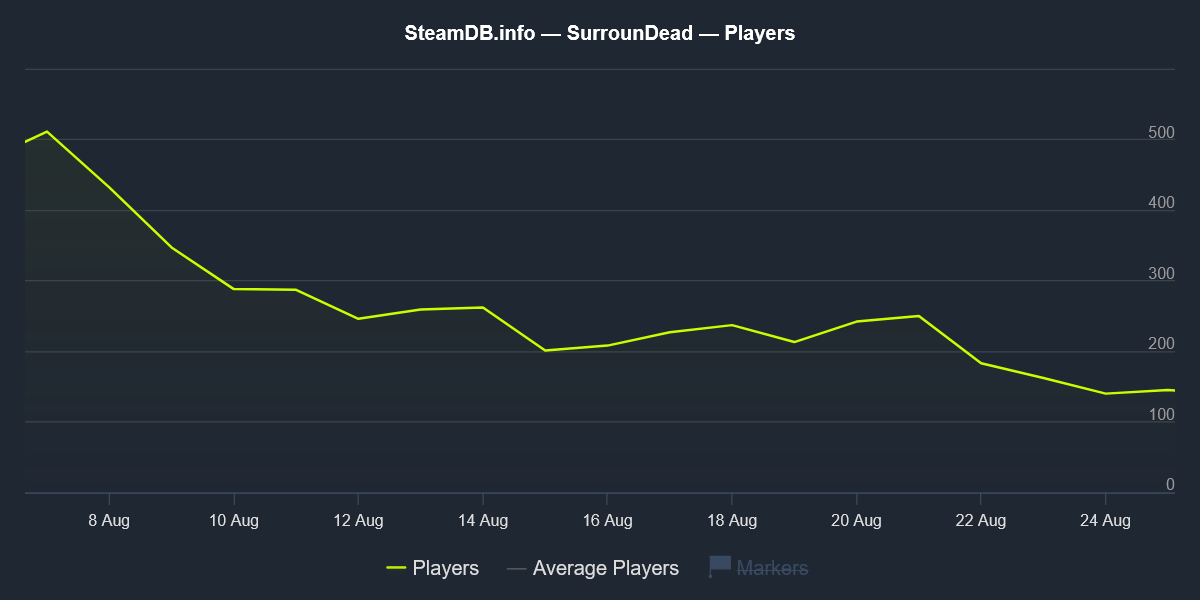
SurrounDead is an indie survival game with online coop, that launched on Steam (no EA) in July 2022 at a price of $15. Smaller game (no MMO), smaller price. Now this game had so little marketing, that nobody really knew it was launching - so it started with less than 100 players. But then it got some press and word of mouth, and shot up to 400 players, a month later. The graph then shows the steady decline for the next two weeks after that. The game would then go on to have roughly 100-300 ish players for three whole years. And I don’t know what happened then, but sometime around April/May 2025, numbers started to increase. First slowly, then faster, then like an explosion. The game peaked at almost 11,000 players in September 2025 - and right now, as I am writing this, it has 1,500 people playing.
And here’s our last example with a graph:
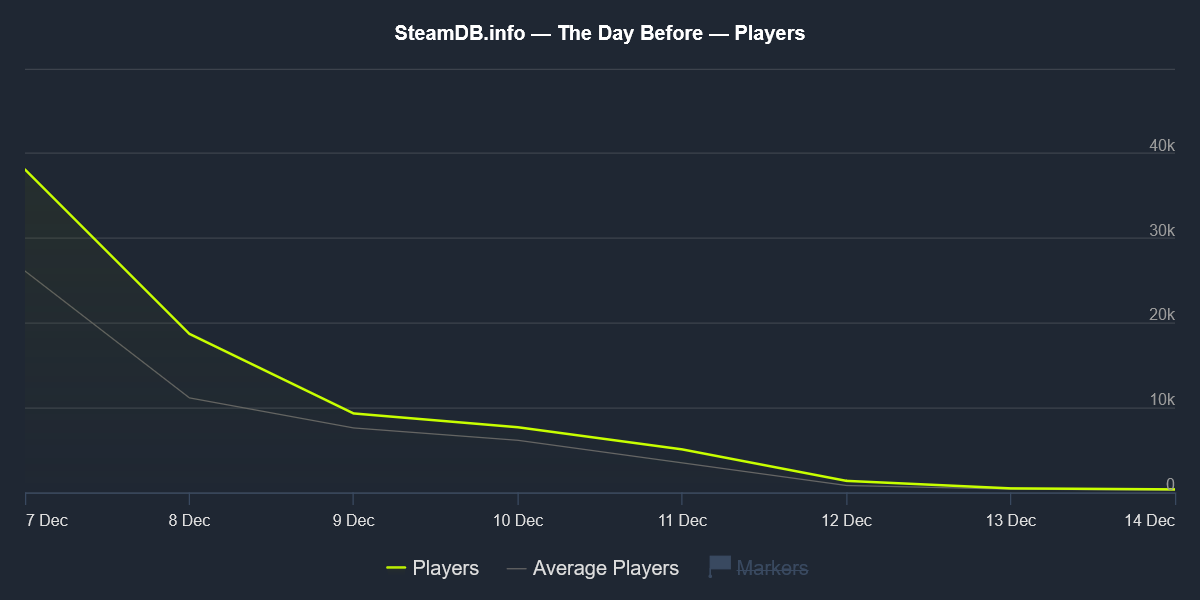
Again, not an MMO, but an indie survival game with online coop. This one launched on Steam without EA as well, at a price of $40. It had nearly 40,000 players on it’s first day, half that the second, again half the third - and so on, and so forth. After a week it was down to 350, after three weeks it basically hit 0 players.
I added these two non-MMOs, because I couldn’t find any MMOs that were such clear outliers. One that started looking very tiny, then took off. Another example for that would be Subnautica - that also launched to very small numbers initially, before becoming a huge hit later. And one that started huge, only to fail very hard. Another example for that would be Crowfall, which during it’s first, quite promising week, grew from 3,000 players all the way to 4,000. Only to then completely reverse that trend.
What I wanted to show here is, that it’s not always obvious how a game will do, from looking at it’s first two weeks. Even with a month or two of data, you still cannot be certain about the fate of a game. And launches that do look very similar to each other at first, can lead to completely different outcomes long term.
Stars Reach EA Launch
So, how does Stars Reach look?
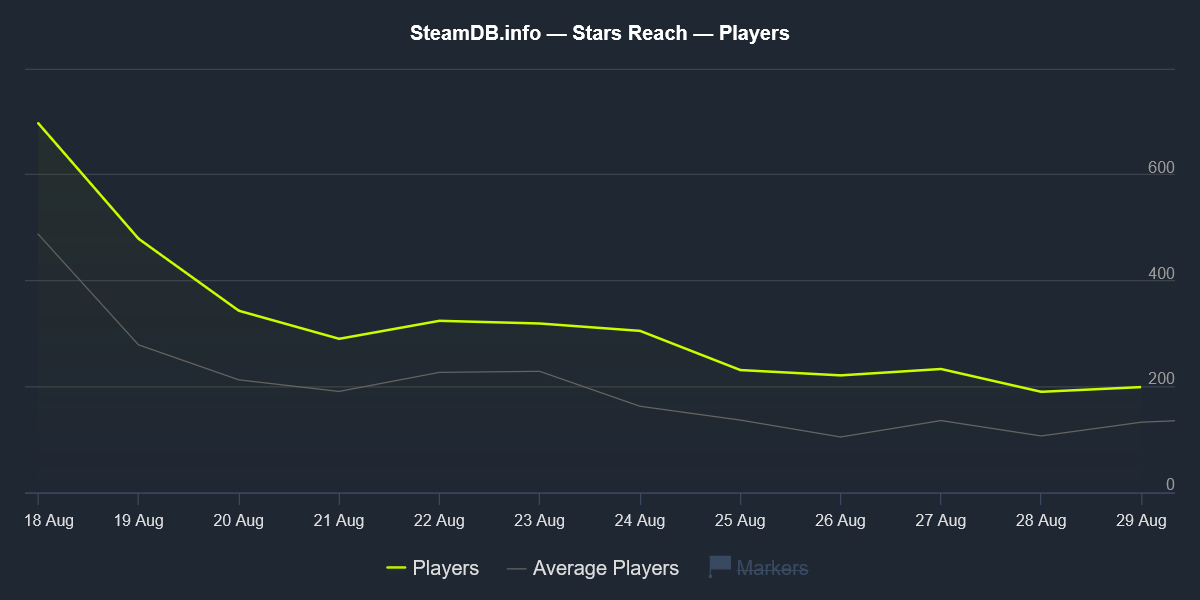
Not exactly very good. But not catastrophically bad either. Let’s look at this in much more detail first - and then I will give you some extra information, that changes the interpretation of what we see here, quite a bit. Because, there a few weird things going on here, that seem inexplicable at first - but there is actually a very good reason that perfectly explains all these oddities at once.
But first: ENHANCE!
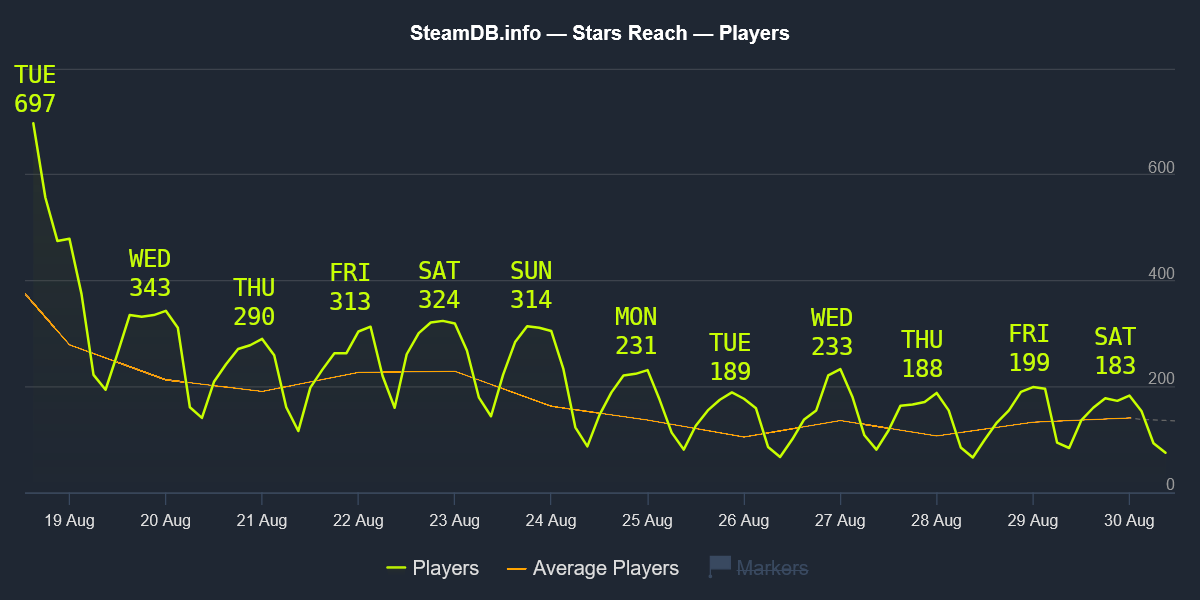
These are hourly numbers, instead of the daily ones we saw in previous graphs. For those older games, SteamDB doesn’t keep the hourly stats anymore. So we had no choice there, but go with the daily stats. I added in the peak player number for each squiggle, rather than for each day in UTC (as steamDB does) - because I don’t like one squiggle to potentially count for two days.
First thing you’ll notice, is that ~700 player number right at launch. That’s not a lot, but as seen above, also not unexpectedly small for an indie MMO with little to no marketing. That initial number is mostly hype based. Crowfall had a lot more hype and marketing and 60,000 backers - and launched to 3,000 players. Compared to that, SR had 6,000 backers, relatively little launch hype and marketing and launched to 700 players. Doesn’t say much. The Day Before shows that even launching to a massive 40,000 players doesn’t help, if they then all leave within days.
The second thing to notice, is that Wednesday has about 50% the users of Tuesday. That is a very steep drop off. And the fact that we don’t see any more drop off for the entirety of Wednesday through Sunday (five whole days!), makes that really, really weird. Sure, Wed is little more, Thu a little less - but overall rather flat. That makes that initial 50% drop off really unusual. Put a pin in that and remember it, because we’ll talk more about this later.
Then you’ll probably notice, that the second week is overall lower than the first, but equally flat-ish. We’ve seen above, that weekends tend to be a little higher than weekdays - and especially the launch-weekend might attract extra players. So a drop Monday isn’t unusual - the one on Tuesday though is. Might that be the server lag and rollbacks showing effect? The patch on Wednesday did bring back people - who left again on Thu when they noticed the lag still wasn’t really gone. Then the Weekend brought a slight increase again. Overall 200-ish players all throughout. The big question now is: will week 3 be the same or drop further? Impossible to predict, at this stage - that much we learned in the previous chapter.
Another thing to take a look at, are the Steam reviews:
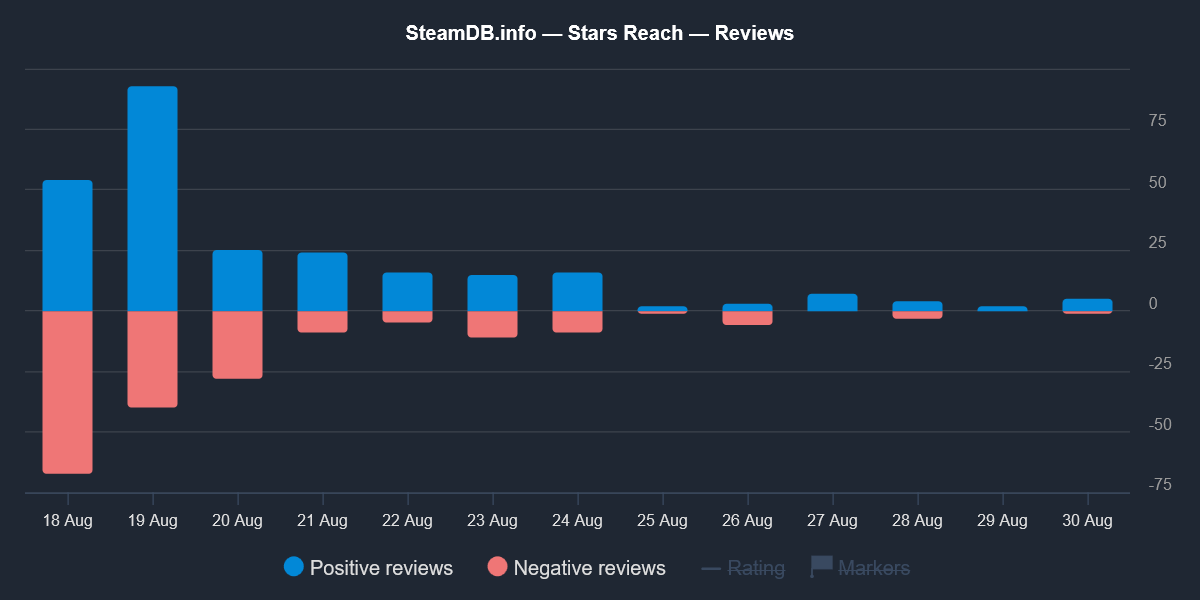
If you checked on launch day, right then and there, you might remember the review score starting “negative” and then getting “mostly negative” before settling on “mixed” - but that’s nothing but a bunch of people giving a bad review within less than an hour of launch. Most people who liked the game, were too busy playing, to be writing reviews, and that’s why we see so much more positive reviews on day 2. But technically player impressions always were mixed - it’s just that time delay that skewed the overall at first.
These SteamDB graphs do show all reviews - but Steam does not count backer’s reviews, as they received a game key and didn’t purchase on Steam. That makes Steams numbers worse, and that in turn shows that Backer reviews tend to be more positive. Even more interesting though, is the following:
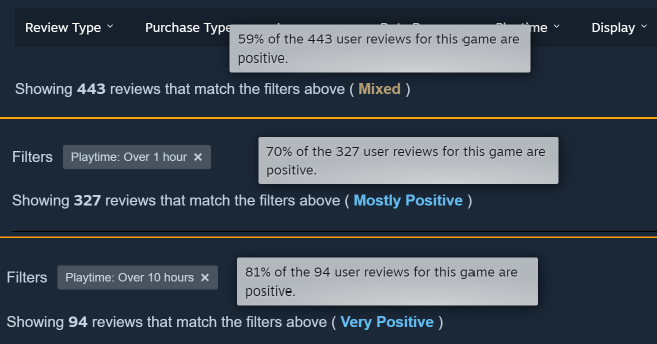
Out of all reviews, 59% are positive. But switch to only reviews with 1 hour or more of playtime, and suddenly 70% are positive. That’s not only mostly positive territory - that’s also an unusually huge jump up. To a certain degree it’s normal, that people who dislike a game play less, than people who do like it. But this gap we see around the 1-hour mark, is unusually high. Normally you’d not expect such a clear cut divide at such a low time mark. And that is another thing to remember and put a pin into. Why? So we can connect the pins with a crisscrossing web of red yarn, of course. Silly question.
What else is there to look at?
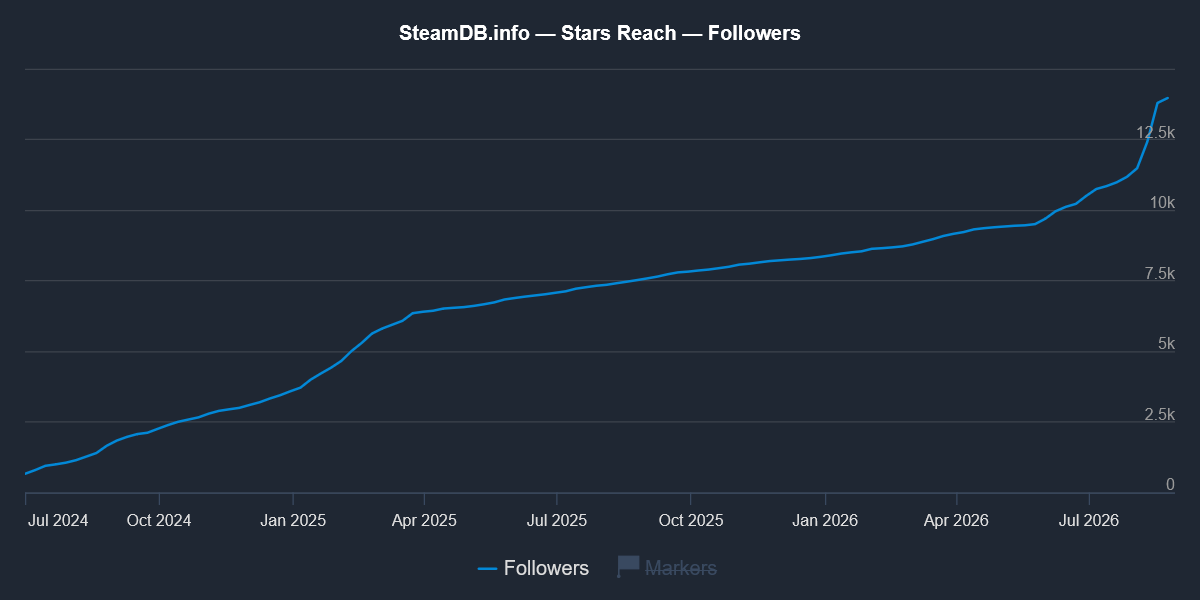
The followers show very steady, organic growth. A little boost during the Kickstarter in February 2025, a larger jump right before EA launches. Most interestingly: the line then continues the usual growth. No drop-off and decline like The Day Before, not mostly flat-lining like Fractured Online. Interest in the game is actually still growing and doing so at the normal rate. Wishlist activity seems to even have increased - as far as I could tell from my daily checks during launch week. There are people who are waiting on the final 1.0 launch - not a bad idea actually, if you don’t want to deal with the bugs and the unfinishedness of it all.
A Little Detour
Before we can dive into interpreting what these numbers mean, and how to explain these things we noticed and put pins into - I have to tell you a little story about the early days of Stars Reach testing. Just as a little primer, to help you understand what I’ll be talking about later.
Many things that are in the game now, were still missing and not implemented, back during the first playtests. That includes all the onboarding stuff. First you simply started in some house on a planet, with only a short welcome message. The explanation of what little you could do in that test, had been given in the invitation email. And that’s how things stayed for I think roughly half a year. The house was replaced with an outside ReLife station, but the message stayed the same.
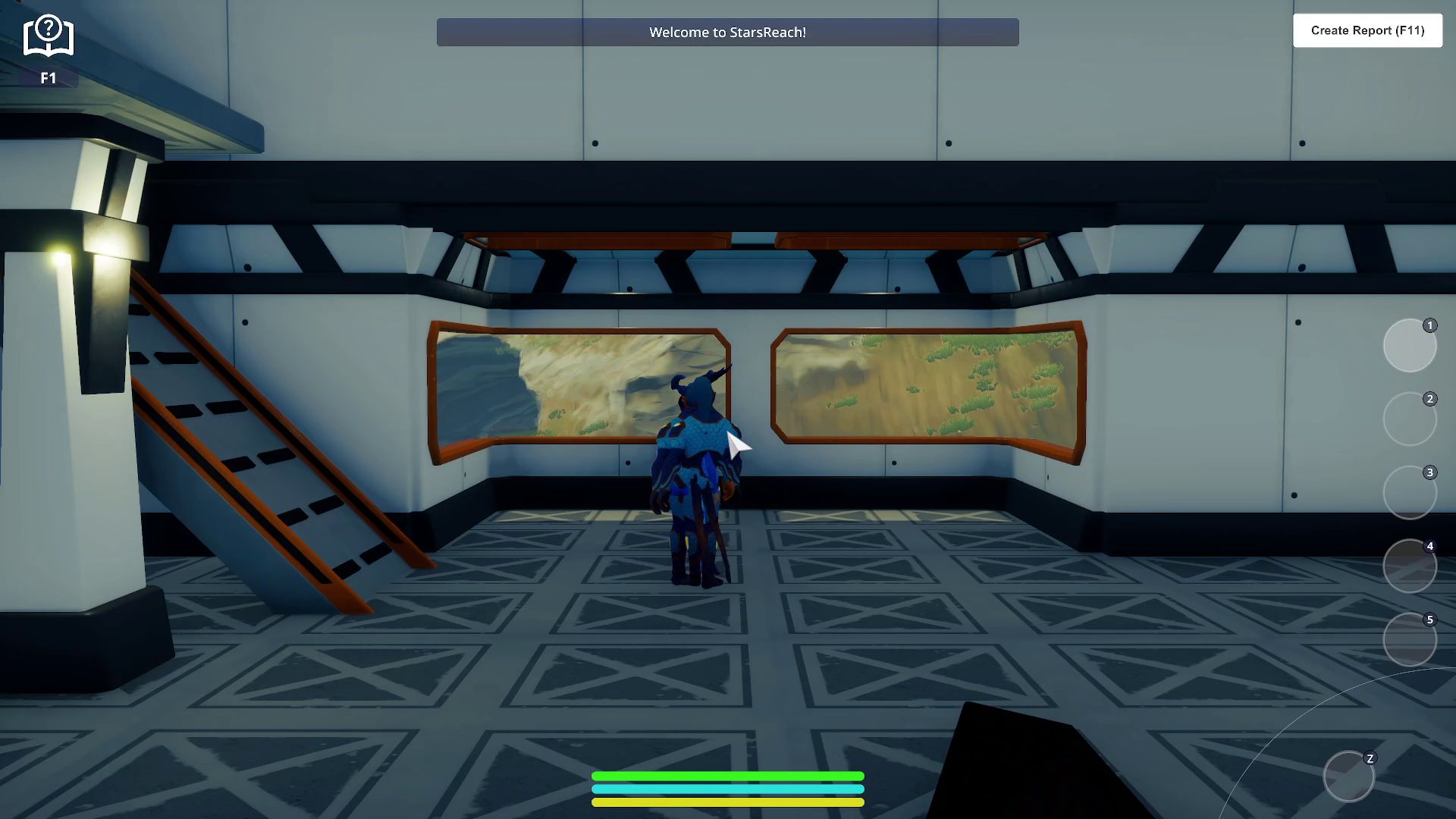 “Welcome to Stars Reach!” - nothing else
Then, sometime late 2024, early 2025 a series of pop-up windows was added. Just next-next-done, a few paragraphs of text to flip through. Many didn’t read it of course. It took roughly around another half year, before we got the first WIP placeholder character creation screens in summer 2025. But the text on these was an introduction to the lore. The previous windows told you to move with WASD, how to switch tools, and to just try digging with LMB - or something like that.
It still kinda worked, for the very simple reason, that every who’s ever played any survival game (and who hasn’t?) understands the very basic first steps of collect some branches, hunt some meat, make a campfire and grill a steak. And this mindset, this approach of treating it like a survival game, just worked. First thing a new player does, is step a few feet away from the portal and hold down LMB - as told by the pop-up windows. The terraformer beam fires, a glowy soil-doober flies into your backpack, a “soil +1” notification appears on the side of your screen, and a big “+20 discovery xp” floating text pops out right in the center of your screen. Or wherever you have been digging.
That’s the very first feedback you get to doing something in the game, and it’s great. It immediately makes you want to try more. So you dig some more - but alas, you already know soil - no more discovery XP. But you get to see a hole form - the terrain transforms and changes shape, as you dig into it. But wait! Let’s run over there. I see rocks! And tada! Discovery XP for some variety of stone. Do I see a different color of rock over there? Run over, try digging that up as well. So you chase those discoveries for a bit.
It all feels quite satisfying. And suddenly you stand underneath a few trees and there’s flowers, and mushrooms and berry bushes around you. And your mind springs back to when that pop-up said, you can switch tools by pressing 1 through 4. So, you try pressing a few of those numbers, until the message appears “Harvester equipped”. That sounds interesting, right? Or at least, it’s more understandable than “terraformer”, “omniblaster” or “pathfinder”. Unlike with those others, I do believe I can guess what a “harvester” does.
So I aim it at that berry bush and hit LMB. Same procedure: glowy doober, berries +1, discovery XP. And that’s it - I’m hooked. And that moment I’m already committed to spending at least the next fifteen minutes to half hour getting all the discoveries I can. Honestly, I spent closer to an hour, when I first encountered this during the playtest. There’s simply no need for an NPC to tell you what to do, and offer a reward for it. In fact, that feeling of figuring things out your own, not only feels more satisfying - it also fosters that mindset where you are trained to expect the game to reward you for trying things. For experimenting. It makes you wonder what else you can do. You are given tools and actions (game designers like to call these “verbs”), and it’s up to you, to find creative ways to use them.
Then, at some point, you start to wonder, where all that stuff goes, that you’ve been collecting. So, you wanna check your inventory. Your backpack. You got some berries to eat! It’s of course pressing “I” like in a million other games, but you didn’t have to remember that or figure it out yourself. The game prominently showed “press F1 for help” on the screen at all times. And at some point the tutorial even taught you to press F1 to look up stuff. And that F1 help hat a landing page that used to look like this:
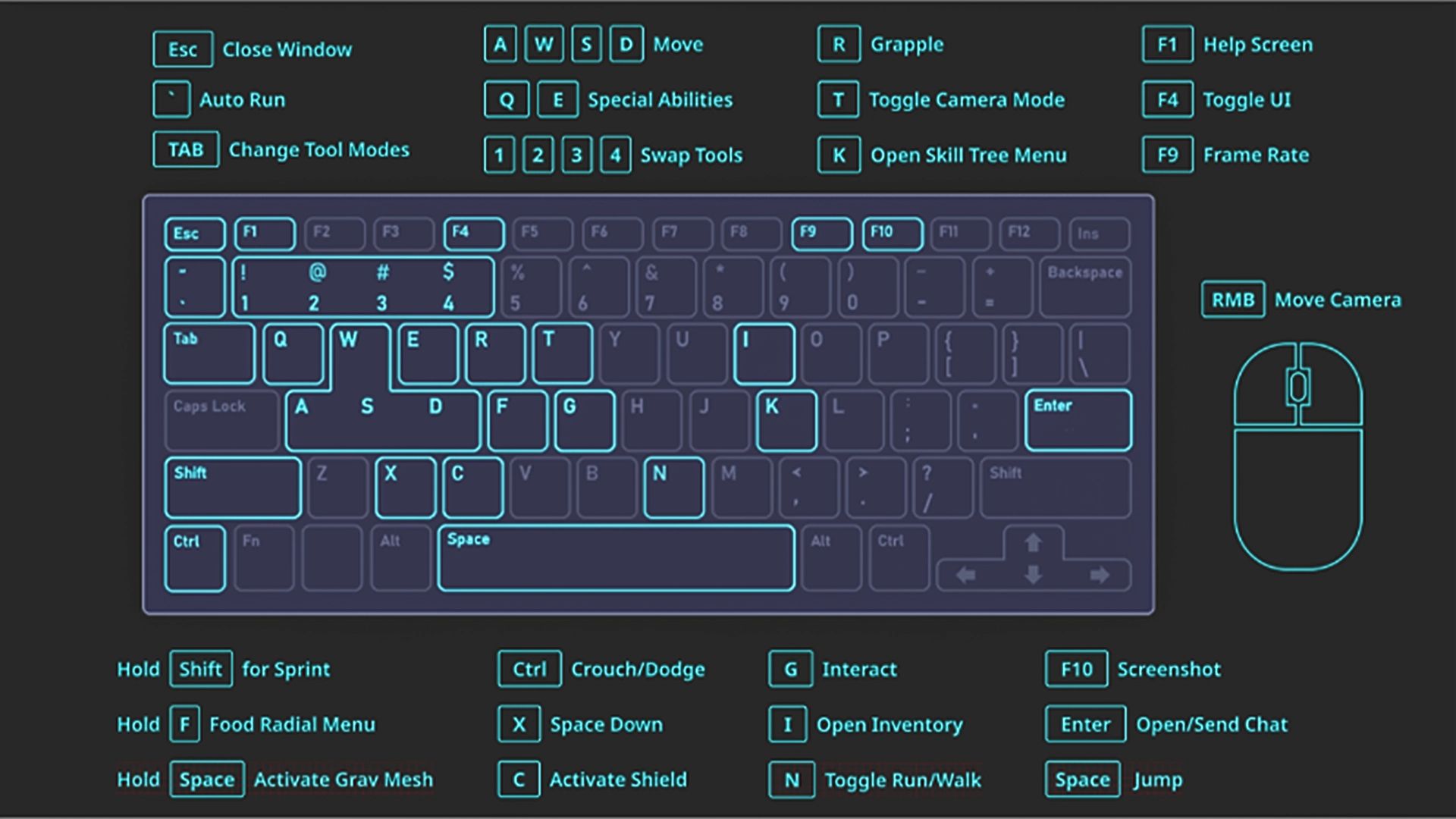 Every time you pressed F1 - you would immediately see this.
To me personally, this is the one most helpful thing that a brand new player could ask for. And “I” for inventory is shown, right there. I will never understand why this screen has been removed. I pleaded with developers that this is the most important help-screen and that it has to be brought back - and they said they would. But they never did.
I understand that it’s tedious to update it every time there’s a change, and that with key-rebinding it ideally should become dynamic, and that’s a lot of work… but just label it as “defaults” and leave it in for now? Completely removing that seems like such a big mistake. Why completely remove it?
Anyway - back then, you could quickly press F1 - see that it’s “I” for inventory, and that’s all you needed to find your berries. But - the very first item you’d see in your inventory, wasn’t your berries, or the branches, or some soil you had picked up - it was a thing called “camp kit”. Interesting - consider my curiosity piqued! So, in that version of the game, you had to randomly figure out by yourself, that you had to right-click the camp-kit to use it. Things weren’t perfect back then - but once did manage to overcome that hurdle, you’d be able to place down the camp.
And back then, that starter camp you placed down, would contain a camping stove right at the get-go. So you click (I know, back then you had to press “G” to interact - no I don’t want to talk about that.) on that stove and a crafting window pops up - showing you two recipes available: mushroom skewer and meat kabob. And if you had picked up a few mushrooms or gotten some meat from animals you’d killed - you could easily create those. Eat them (again right click in inventory) and get a buff to health or stamina, respectively.
At this point - and without the need for any NPC, any quest giver, any text-popups, any rewards, any busywork tasks - the player has learned to move, to dig, understood how the terrain can be modified, to harvest, to craft, to use consumables and used the inventory. The player doesn’t know how to crouch - but they do know they are just one single F1-press away from looking up how to do it.
But most importantly - and that’s the really central part that I want to stress here - the player has been taught to try things, to experiment, how to figure stuff out, and that doing so is rewarded, and that there’s no failure, no punishment. Just take the tools you’re given and see what you can do with those. And - the player also has discovered the deformable terrain - within the first 15 seconds of playing. Seen soil flow down a slope. They are only one tiny step away from coming up with the idea: “What if I cut through here entirely? Does the rock then come crashing down?”. It’s more a matter of “when”, not “if” they come up with that idea.
Within just a few minutes of playing, the game has shown some of it’s strengths, probably impressed the player with it’s simulation, taught and reinforced the idea that in a sandbox you have to figure some things out yourself, and are rewarded for experimentation - not with scripted rewards like currency or items - but with the genuine joy of discovery and learning. You immediately get, that this is not a game about following the carrot on a stick that’s being dangled in front of you.
Why It Was Changed
Now, this “non-tutorial” onboarding I described above, wasn’t perfect by any means. It had a lot of issues - but solvable ones. It needed a lot more polish, and more quality of life, and more invisible guidance (like highlights around interact-able items didn’t exist yet).
For some players - who might simply need more hand-holding - a little virtual companion that can give hints and tips like “try digging”, “switch to a harvester”, “try harvesting a mushroom”, “try placing a camp”, etc. - might be great. Or in lieu of that, just context-sensitive help. Back then you didn’t have info unlocks in the Galactopedia yet either - which is another great tool to help, if you can get players to use it. And keep it well sorted.
But aside from these polish-things, there also were some more substantial issues with this approach. The biggest one probably being that the area right around the starting portal quickly turning into Swiss cheese, when every player tested their mining beam there. Within minutes, the terrain would became near impossible to navigate, especially for a new player not experienced with the GravMesh and/or Grapple yet. These holes in the ground right around the player spawn point, became a real nuisance pretty fast. That’s definitely something that would have needed solving.
Another issue was that people would stick to that survival-game mindset a little too much. But with the power of hindsight, I honestly see that as pretty minor flaw now. Yes, people did not understand, why the devs wanted to introduce skill limits and specialization, and interdependency - and why not every player should just be able to craft and build everything. Like is typical for a survival game. But I think, that mindset is even useful at the start, to get players to try out everything - and since skills can be deactivated later, and you don’t get locked in - there’s nothing wrong with players trying to do everything at first. I mean, the entire tier 1 of all crafting recipes could even be kept intentionally small enough, that it’s easy to do it all on a single character. Once players get into the higher tiers though, they will quickly discover by themselves that they want to specialize - and not do everything by themselves. Not because the game is forcing and limiting them - but because there’s an overwhelming amount of different stuff to do and train. After all - survival games are very sand-boxy, and thus not all that dissimilar in gameplay and player mindset.
The main reason to move away from this approach to onboarding though, may have been more technical in nature. If you launch to many thousands of players, you will need hundreds of such starter planets, and you’ll also need to add new ones regularly. You can’t dump a new player onto a planet that’s already been completely messed up by those who came before him. Creating a “tutorial area” that’s completely static and unchangeable comes with many benefits: it acts like a buffer to player numbers, as you can easily spin up as many instanced copies of that as you like. Since nothing can change, you can shuffle players around between instances as needed - nobody has to stay in the same instance for sake or persistence. There’s nothing to save either - the state of these hundreds of planets does not need keeping or saving. The simulation can mostly be turned off, as the terrain can’t be deformed anyway. And after that initial influx of thousands of players is over - you don’t have hundreds of chewed up planets lying around, that you can’t delete yet, because of a few stragglers who simply haven’t finished the tutorial there yet.
For a big, thousands-of-players release launch you will likely need something like that. But for a 700 player Steam EA launch you surely don’t. Completely unnecessary overkill in that case.
Anyway, the developers came up with a new approach to onboard players: the hallway. And it was bad. Really bad. It didn’t actually teach players anything. It tested them. Move, crouch, jump, climb! Can’t do it? Well, then you’re not allowed into the game. The philosophy behind the onboarding changed completely. What was a no-pressure affair that invited and rewarded experimentation, allowing players to figure things out at their own pace and in their own order - became a strictly linear “follow-the-instructions-or-be-punished” kind of thing. Testers hated it with a passion. And that it was always broken, and always got players stuck with no way out, other than creating a new character and hoping it works this time - didn’t help either.
I don’t think the developers had many metrics collected for the original “dumped-on-a-planet” onboarding. That stuff just wasn’t implemented yet. But they had tons of feedback of Kickstarter backers - about the holes, about lack of guidance, about not knowing what to do. Ultimately, not many backers stuck around to playtest the game regularly. Many thousands tried out the game, but ultimately left again - to wait on a more finished, more complete game experience. But the Kickstarter was a success and did well. Almost 6,000 backers pledged over 800,000 dollars. As lacking as the “dumped-on-planet” onboarding may have been - it did manage to convince people that the game has potential. Backers trying out the game for only up to two hours, could see that the simulation was real and worked, that the terrain deformed, that water flowed, etc.
Could a better onboarding have led to even more success and even more backers spending even more money? Sure, definitely - but it also could have been a lot worse. I’m sure with the hallway it would have been a lot worse. Good thing that wasn’t there yet.
The developers did have metrics for the hallway though - and the numbers were bad. People hit a wall and were quitting the game within minutes. That seems to have led to a change in direction for the development. The onboarding experience became a development focus, and the big goal was formed to get the mean (average-ish) player to stay for one hour, before quitting. Now I don’t know if more than half players did stay for an hour during the “dumped-at-planet” days - but as far as I am aware, neither do the devs, due to lack of metrics. But with the hallway, new players definitely did not stay that long. Anyone who did not get stuck in the much maligned hallway, was then dumped on the TPL station. And that second part may be more of a problem than most realize.
The thing is, when you start on the TPL - there is nothing to do there. No ground to mine, no plants to harvest, no creatures to scan or kill (except further out in space), and generally none of the strengths of main features of the game are visible. In it’s first iteration, clearly recognizable portals to the planets were on platforms right in front of the station - and players easily managed to find their way down to a planet. That was later changed, and the wormholes that replaced the portals were far less obvious in their function, and far out in space - often hidden behind asteroids or the station itself. Many players had no idea they could just jump off the station and fly out into space. Yes, there was a huge, screen-filling text-pop-up that would also mention that, among many other things… but at that point in time, players had already been bombarded with so many of these text-popups, most of them explaining trivial stuff like WASD and mouse-clicks - that many were only skimming over that, if reading it at all. The fact, that “ESC” was both used for “confirm/continue” AND “close window” didn’t help either, especially since it always seemed to close the important info window first - and confirm the front and center modal popup second.
Players were told to pickup missions, but the mission terminal was on the second floor, and somehow some people seem to struggle finding that, since they only look for things on the same level they are running around on, and ignore the stairs… Anyway, once you had a mission, you also had a waypoint that helped find the wormhole and thus the way down to a planet. And then - once down on a planet you could still dig a hole, get discovery XP, figure things out and all that stuff - but at that point in time, you had already been taught to follow instructions. Or be punishes. And the instructions of your missions are very clear. Go to the marked spot, pick up a mushroom and return. While you could still diverge from the path and explore the planet, that chance of teaching the player to just experiment and discover had already passed - because now a “running-chores-for-rewards” mindset had been firmly instilled instead. That the missions are very boring and not something you’d ever want to do, if you weren’t forced to, because it’s the only way to earn the currency you need to train skills or buy items or do anything.
Can you see how we now have gotten from “dumped-on-planet” and seeing the game’s strengths within 15 seconds - to spending 15 minutes playing an entirely different game, before even being allowed on a planet, and then under explicit instructions to not just explore and experiment? The fun of the game got a lot more difficult to find.
Because of the negative feedback, and because the reworks didn’t help the metrics, the hallway got eventually removed again. Replaced by Haven - a static planet. Basically Stars Reach without it’s world simulation. You can’t dig, you can’t log trees, you can’t modify anything. A world that’s not alive, in a game that’s supposedly all about living worlds. That’s the moment where some players just quit, write a review that says: “SCAM - promised living worlds, but it just the same static scripted nonsense as all other mmo’s” and gets a refund. But I’m getting ahead of myself. Originally Haven was filled with a series of linear, on-rails quest-chains. Talk to an NPC, pick up quest, run to the quest marker, follow instructions, come back, turn in, get scripted reward. Rinse and repeat. The number of quests added that way, came out to around roughly one hour of playtime for a new player who’s not rushing. I guess… goal achieved then? Reaching one hour of playtime was the goal right?
Well, problem is, after that one hour, these people still got dumped onto the TPL, had not only no idea about how the game worked - but instead had an idea of how they thought the game worked, that was the complete opposite of how the game actually works. In Stars Reach, there are no NPCs giving you quest-chains, and scripted rewards. That’s a completely different game - player are taught something completely else entirely. They may have reached 1 hour of playtime - but at the cost of loosing even more people, after that first hour. People who like that sort of quests (and who aren’t too busy playing WoW, FFXIV or SWTOR), quit when they notice that after Haven there isn’t any more of that. People who a bored of that type of quest and want something different, and manage to get through the for them very disappointing Haven, will quit in tears when taking their first mission from the mission terminal. It’s just like quests - but worse! Only people who completely ignore all that the game has taught them so far, mostly ignore the missions, and go explore for themselves instead - have a chance to discover the other Star Reach. The fun one.
But now… it takes more than an hour, to be able to discover that. To be able to get to the place, where you can see the game’s strengths and discover the fun. Put a pin that! Remember this - this is gonna be important.
Tester feedback was mixed. Some loved the quests, the NPCs, the lore - other hated being put on-rails, and the bait-and-switch from NPC-quest-chains, to mission-dispenser terminal. Heated debate ensued, and ultimately the developers sided with the testers that disliked the themepark quest-chain approach. They agreed the game was teaching the wrong thing. So Haven got reworked, and basically made teach less overall. That means it teaches less of the wrong thing - but it still doesn’t teach any of the right things. That experiment, discover things, get rewarded loop that “dump-on-planet” had - there’s still no replacement for that, nothing that would teach you the same things or anything like that. The game stopped teaching “themepark”, it never began teaching “sandbox” instead.
Ultimately, Haven got shorter, far less than an hour now (make a note to that previous pin: less than one hour now), unless you try to go completionist on it. And doesn’t really teach you much at all. Teaches you some keys, I would even go as far as making the claim, that this F1 help screen that showed the keyboard did a better job at that. This keymap that got removed… way better at teaching the basic controls than Haven and the hallway combined. Why would you remove that? I have no clue.
More Pins
There is some more anecdotal evidence that I want to throw in here:
I genuinely felt like I’d played two separate games—one of them was an eerily lonely, aimless random mission generator, and the other was a jolly cooperative builder that did legitimately charm me.
[…]
The major issue? I had to go out of my way to find these people doing cool things — rifling through a Discord, going on a fan-made site — rather than organically being directed to these UGC zones through a better overworld system. If anything, the mission boards feel like a flat misstep that give players the wrong idea about what the game is trying to do.
Put a pin in that: It feels like two very different games. And the “bad one” is what the game shows you (especially during it’s first hour?) - and the “good one” is what you have to go dig for and discover on your own.
On the official Discord I ran into a player who was trying to get a specific item, which he couldn’t find offered on the TPL market place. When I told them, that the game had 5 space zones, each with it’s own TPL, it’s own market place, and it’s own planets - and that players could travel between all of them - their mind was completely blown.
To a new player, this is completely invisible. They see Haven, they see one TPL, they see maybe only two planets, both of them possibly mostly empty - and a mission treadmill for pretty boring, generated missions. They game simply does nothing to communicate it’s scale, it’s strengths, it’s potential. It presents itself as something else entirely. Put a pin in that as well. But it’s basically just another version of the same thing.
Connecting The Dots
I claim Stars Reach has a high-value, emergent, systemic game buried behind a low-value, linear, confusing first-contact experience. The first hour is disproportionately bad at communicating what Stars Reach actually is.
In the first hour of the game, you play through Haven, a hollowed-out former themepark quest-chain set-piece. It feels unmotivated and purposeless, and doesn’t really teach you much of anything. You do three or four NPC-driven quests there, get some money, and are sent off to the TPL. There you are introduced to the mission treadmill. Take the quest-treadmill of a themepark, and remove everything that’s good about it (narrative, lore, NPC talk, reward items, story progression) - and these “pick a mushroom” missions are exactly what’s left over.
And then, to the new player who just joined - there seems to be nothing more. Sure you could run more missions, train a few skills… but for the most part, there seems to be no more content to the game. They’ve seen Haven, they’ve seen the TPL, they’ve seen the two (empty) planets… that’s it, right? That’s all the game showed to them. That’s all they were told about. And they were never taught to explore and discover for themselves - it was always a “follow the instructions” kind of affair. And the instructions ended. They have done everything that instructions existed for. They’ve seen all there is to the game, right?
So, why would those people play for more than one hour (just do more missions? Nothing else to do) - and not just quit now, write a bad review, and take their refund? Have they seen anything that seems worth spending $30? Have they seen any reason to stay? Have they been given any reason to like this game?
BUT!
At same time, another player might get lucky - and randomly spawn into a very specific TPL base in a very specific system. Their first mission might lead them down to a planet, where 20+ players are very busy setting up their first batch of crafting stations. They are welcomed, invited to join, given access to these crafting stations, get handed a few free items, and more importantly are given tips and explanations.
They ask questions, and are told that this is a guild - but guild membership isn’t a requirement to join the city, which they plan on building. They are currently building farms for the materials they need. Miners are hollowing out the asteroids in space to get metals in large quantities. The crafters are trying to progress through the skill trees to unlock more stuff they need. They hope to be able to build the first house/building within the next 24 hours.
They tell you about their plans to have a road/concourse along here and out there into the distance… and then shops and player vendors in this district, and then player houses more designed as living spaces have their own districts - but as long as doesn’t overlap public infrastructure plans, players are allowed to build wherever they want. They explain how every profession feeds into each other. How everyone is part of everyone else’s supply chain. How they deal with creature spawners, how they hope to catalogue material quality stats, how they’re currently voting for a mayor.
That player then thinks: “Oh, this is the real Stars Reach. Never mind that first hour - this is where the game really starts.” And they’ll be having way too much fun to write a review right now. They’ll do it tomorrow. And it will be positive. And they will think this game is totally worth $30 - despite all the bugs and jank.
And what’s the actual difference between these two players? Random luck. Because one ended up in a star system where a planet is being colonized - the other did not. These two players, are playing two different games. One of them discovered the real game - the other did not.
This Explains Everything
Now get a bunch of red yarn, because we are about to connect all the pins we’ve put into various places. And we connect them all together, because they are all the same thing. It’s all the same cause.
Why this steep 50% drop on the first day?
Some of these are people who this game simply is not for, and they never would have liked it. Some of these are people who want something more finished, more polished, less buggy. But the rest, are people who weren’t able to discover the real Stars Reach. The people who only saw Haven and the mission treadmill and an empty planet or two. And on day one, there wasn’t any player settlement to be found anywhere, because even the fastest guild needed several hours to get that started. Those early players - they couldn’t get lucky and discover something like that, even if they visited every last planet of the game.
Why “mixed” overall, and “mostly positive” for 1 hour+ players?
Because anyone who does discover the real Stars Reach, will play for multiple hours at least - while those who don’t discover it, have no reason to player for even one hour. Why run more missions - they aren’t gonna get any better! As said above - there’s like two games here, and one of those games is “mostly positive”, and the other one is “mostly negative” - and put together you get mixed. But the first hour of play falls into “mostly negative” for everyone - and only if manage to find the real game after that, then will you discover the strengths of the game, and what it’s actually about. Before that, you simply have no way of knowing.
What has the Onboarding to do with that?
That’s exactly what players are doing for those 0.something hours, before they land at the TPL, where the game’s playable content seemingly just ends. That’s why not more negative reviews bleed over into 1hour+ territory, and why that divide is so clear and that gap so big. People who never discover the “mostly positive” game, see only the “mostly negative” one, and that one hasn’t enough to do, to spend more than an hour in it.
Why is the graph then mostly flat - after that first day drop?
Because the people who do discover the hidden, real Stars Reach - they stay at least a week, or more. Sure, every day has a few more dropping out, and a few new players coming in - but talking very roughly, overall. Of course the real numbers are gonna all be a bit fuzzy.
And What Does That Mean For The Future?
That things can be turned around. Because there is a good, mostly positive game hidden in Stars Reach, that’s worth at least one week of playtime. It’s not for everyone, and some will not be willing to look beyond the bugs and the jank - but there is some genuinely good, high-value game in there. It’s just so well hidden, that seemingly around half of players can’t find it at all. Which perfectly explains the 50% drop-off and the 50% negative reviews.
And it is already happening! Remember how I said that in the first hours of the game, not a single planet had a settlement started yet? How no player could possibly get lucky and run into a guild getting started with a planet? Well, these days, every system has at least one settled planet, if not two. A lot more guilds have started up their city. For a new player who starts playing today, chances of running into a planet that does NOT have a guild on it, are getting lower and lower.
Remember that PCGamer article, where he writes he had to go out of his way to discover that one guild that was doing cool things? That one guild was faster than the others, because they are the only guild who had done it before, during playtest. They knew how to bootstrap a planet, and had plans and organized division of labor and things. But others are catching up now - they are by far no longer the only guild, building a city and organizing things. It just took a while. But none of that could have existed within the first hour or two of the game launching. In fact I saw a 0.1 hours negative review, that declared the game dead, because the vendor at the TPL had nothing on it for sale. No economy = dead game. Problem is… 10 minutes after launch, of course nobody is selling anything yet…
As time passes, and the player settlements in the game mature, and the economy becomes richer, and item availability goes up and prices go down… the good parts of the game become more and more visible. People still have to get through Haven - but after they’ll be taught the right things - by other players. And that’s a very sandbox thing to happen.
But those early players of that initial 700 player wave… they had nothing to see or find there, and the game did nothing to tell them what to look forward to, either. There is definitely some wasted potential there. Those 700 might have grown into way more, and more of them might have stayed for longer - had the Real Stars reach, it’s strengths and it’s fun not been that well hidden. But it’s not over yet either - we’ve seen other games in the first chapter of this post, which did get their best numbers only much later in their life. Things can still be turned around.
Right now, the game’s community is doing a great job of providing the onboarding that Haven didn’t or couldn’t. And maybe - as a sandbox game - Stars Reach should lean into that a bit more. There is a “Helpful - Ask Me” title in the game, but that too can only be bought after you left Haven and made some money from missions.
Maybe that whole mission running thing needs to be a bit de-emphasized. Maybe the “galaxy map” should at least get some placeholder static image for now - so that people can see, that there’s multiple space zones to travel to. Maybe there are ways to reduce “TTRG” - time to real game. To shorten people’s stay in Haven, and to maybe get them down to a planet sooner - without first having to go through the TPL. Or maybe the TPL could be made a bit clearer…
Maybe new players could start off on a wild planet. One with a high timer, and still a bunch of hours left. Maybe they could spawn on a random location, somewhere out in the wild, and then be told, they have to find the portal and leave the planet within the next X hours. But no stress - enough time to explore a bit and grab some good stuff. Dig and harvest and get those tasty discovery XP. Maybe build a camp and cook a mushroom skewer. And then, the wild planet is gonna be replaced by a new one anyways.
Maybe players could be encouraged to just try a whole bunch of different professions on tier 1 - since they don’t get locked into anything anyway. Maybe they even have to survey a few points, and craft some emergency signal (that needs a few simple ingredients gathered in different ways), to be able to leave the wild planet they started on. Make it feel survial-game-ish on purpose and tap into that self-explanatory sandbox gameplay of that. Let the player do tier 1 of everything - and then offer them a free unlock of any tier 2 of their choice.
OR - if it has to be a static planet, unchanging, and kinda different from the real game… label it as a training simulation that the player takes while still on the space ship traveling to the garden. You aren’t there yet, but undergoing some training in preparation. That eases that conflict of it being different than the real thing. I’m just throwing random stuff out there - but there’s many ways to change things. The important part is, that the player needs to get to see the strengths of the game sooner, needs to get pushed into a sandbox mindset of experimentation and discovery a lot earlier, and needs to be funneled into the mission treadmill later.
Start with the good stuff - instead of forcing a new player into the weakest bits of the game first.
Conclusion
The game is not doing great in EA. Peaked at just 700 players, then lost 50% of those in the first day. Stuck to 350-ish players for a while, then dropped to 200-ish. Review score (all reviews) is only mixed at 59%, but jumps up to mostly positive at 70%, when you limit reviews to 1 hour playtime or more. Most negative reviews happened on day 1, and ever since day there’s typically noticeably more positive than negative reviews.
The most plausible explanation for all of that, is a mismatch between what the game’s onboarding shows players vs. where it’s actual qualities lie. Right now, it’s basically impossible to make out the strengths of the game, within the first hour of play. And then, it comes down to luck or persistence, if a player is able to actually discover the real Stars Reach.
But the game is definitely not dead yet. The chances of discovering the the good pieces accidentally were basically nil at launch, only became real once the first guild had setup a planet you could stumble onto, and are pretty high now, that many planets are being built out by various guilds. And once players do discover the good parts, they seem to be staying with the game for at least one week.
Overall, the game is still stuck with a mixed score on Steam, and with review numbers per day having gotten very low, this is not likely to change anytime soon. Especially since Steam doesn’t count the reviews of all the backers, since they didn’t purchase/pay directly on Steam. (Steam only adds store-bought reviews to their overall - which currently sits at 53% and would require hundreds of positive reviews, to reach the next threshold of 70%. With Steams method of counting, even the 1hour+ reviews sit in mixed now - but only 1 or 2 percent away from jumping into mostly positive).
New players are now coming in very slowly only, and some of those are still bouncing off, because either the game is not for them - or because the game is still too early in development for them, too unfinished, too unpolished. Early Access is meant to be for alpha status games, that are still in development - but many big publishers prefer to use it for paid betas rather, and as reviews show, many people feel that EA should be for paid betas only, and that alpha status games should not be in there. But those few who do come in and not bounce off for those reasons, now do have an increased chance of stumbling onto a guild-governed planet and get help and onboarding there.
But are enough new longer-term players coming in that way, to counter-balance those who are leaving or taking a break? Not everyone is into building cities and houses, or has already built a small house and is happy with that. Skill progression is still way too high, and so people max out their skills pretty quickly. Item decay is strongly neutered at the moment, and thus there’s reduced demand for repair kits, and virtually no demand for item replacements. Tailoring still seems to be doing okay, as there’s a lot of slots that players can still fill to increase their combat power. But tailors seem to be not too happy with the recipe changes the last updates brought. Combat has lost some of it’s purpose, as these creature loot items seem to no longer be used in weapons crafting. And then there are things like the lag issues and the overflowing inventories, that generally dampen people’s enthusiasm about playing a bit. I’m not saying people are quitting, or giving up on the game, but many seem to be playing a bit less frequently than they originally did first week. There is less of a rush, as things settle in.
The question now becomes how to avoid giving that wrong impression about what the game is, that lead to most negative reviews in the first place - and then how get EA purchases going again, now that they have come down to a trickle. If that’s even wanted - or maybe the goal is to first improve the game some more, then try a marketing push, sale, or something, in attempt of a comeback.